

Similarweb for Revenue
Specter now estimates monthly revenue and valuation, with confidence bands, for every company on the platform.
-

- •

Specter now estimates monthly revenue and valuation, with confidence bands, for every company on the platform.
Every public company has a price every second the market is open. Every website has a traffic number anyone can look up, because Similarweb turned attention into a public utility metric a decade ago. App downloads, hiring, web traffic, funding: the alternative data world has made almost everything about a private company observable.
Almost everything. The number that matters most has stayed dark. Nobody can tell you what a private company earns this month, and nobody can tell you what it's worth between funding rounds. The two numbers on which every investment decision ultimately rests are the ones the entire data industry skips.
Monthly Revenue & Valuation
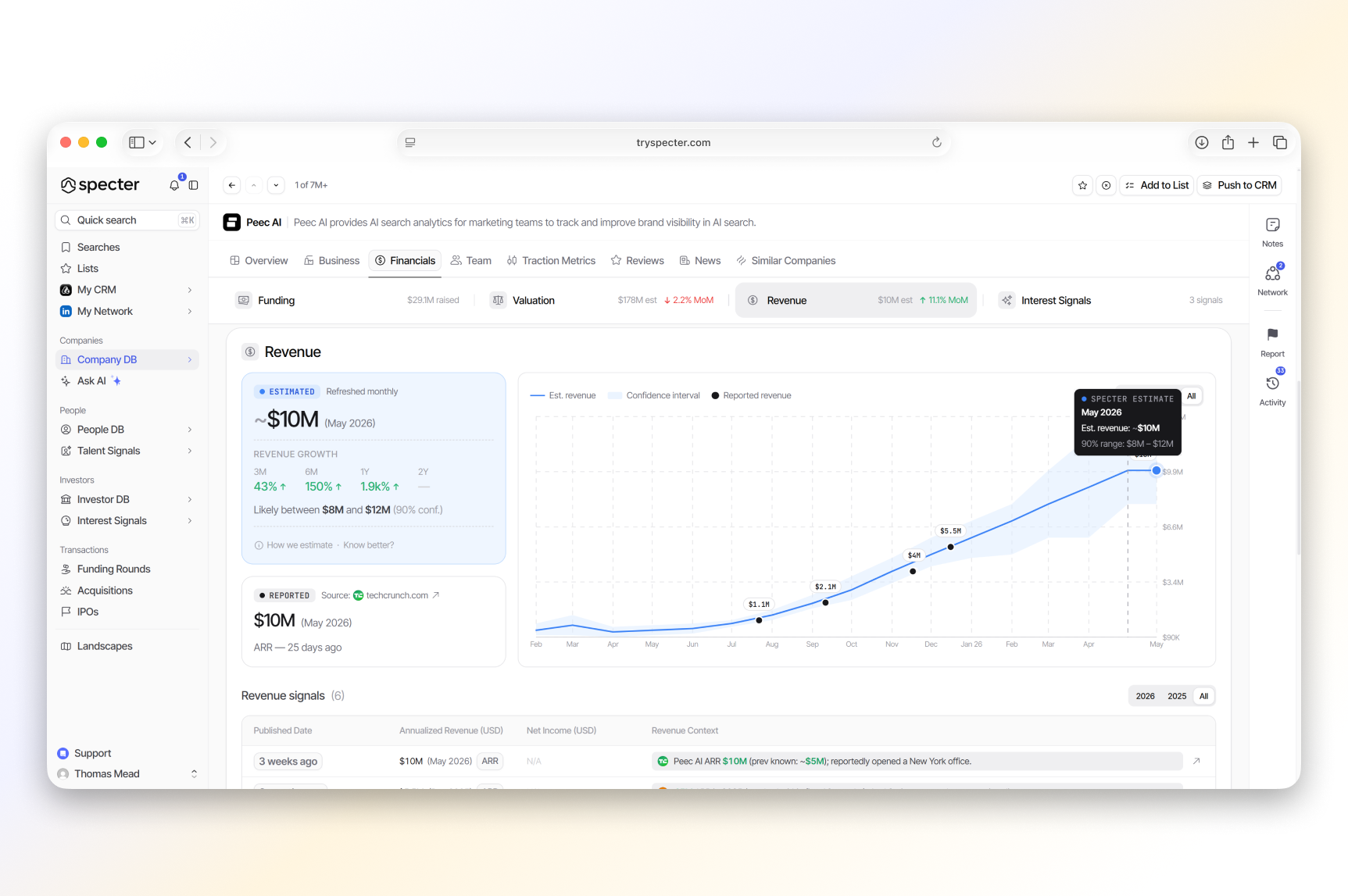
Today we're shipping the missing instrument. Every company on Specter now carries an estimated monthly revenue and a monthly valuation, each with a confidence band, refreshed across the board every month. We built it over the past year with tier-1 funds across the US and Europe as design partners, and benchmarked it against the market before release.
Why this didn't exist
The honest answer is that the available inputs were bad, and everyone had long settled.
The official record is slow if and when it even exists. A UK company with a December 2025 year-end has until September 2026 to file, and the revenue inside describes a year that started in January 2025. German companies get about twelve months. Smaller UK companies can legally strip the P&L before filing, so turnover never touches the public record. American private companies disclose nothing.
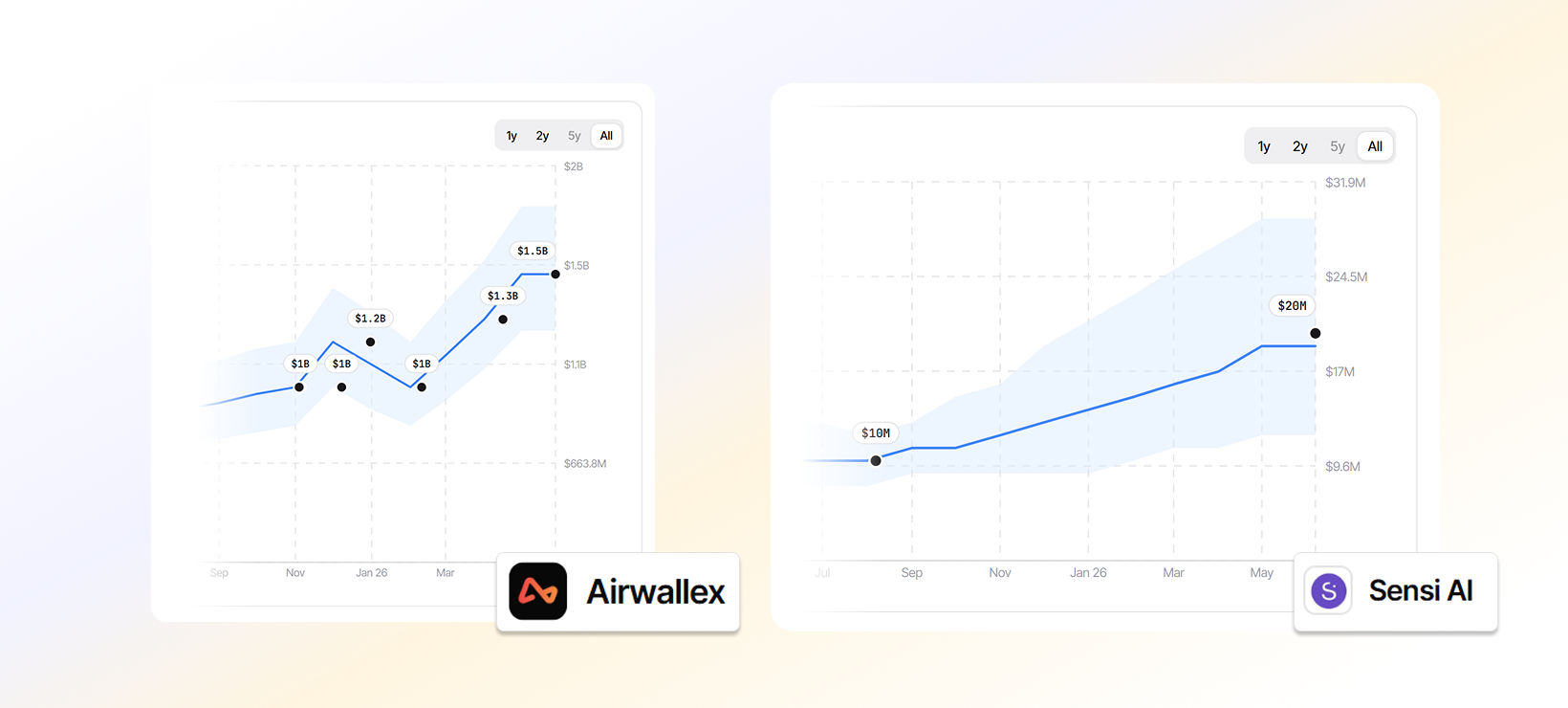
The data platforms settled for two modes on top of that. When a company announces a milestone, the better databases transcribe the headline within a day or two. When it doesn't, you get fiction or a blank. Airwallex announced it had passed $1B in annual revenue last October; check the popular platforms today and you'll find "$200M–$500M" on one and "$258M" on another, attached to a headcount from 2021 and a valuation from three rounds ago. LinkedIn will tell you a $500M ARR company makes "$1M–$2.5M". PitchBook, the most serious of the bunch, gets headcount right and carries the last priced round, but between rounds, the number just sits there, stagnant, and revenue only appears when a filing or disclosure hands it to them.
Transcription or fiction. There was no third mode in which someone actually models the number, keeps it up to date, and tells you how much to trust it. That's the mode we built.
How we built it
Eighteen months ago, we started collecting verified revenue disclosures at scale: ARR milestones, filings from 50+ jurisdictions, investor updates, primary sources, each one timestamped and normalised. That became Revenue Signals, and it taught us the lesson that drove this product. Real numbers are gold, and real numbers are sparse. Most companies, most months, disclose nothing. The gaps are where a model earns its keep.
The revenue estimate is a gradient-boosted ensemble (XGBoost) trained with quantile regression, so every live estimated valuation and revenue datapoint ships with a central number and a confidence band straight out of the estimate. It draws on the 250+ data points Specter already tracks on every company, spanning team, traction, funding, and market context, calibrated against tens of thousands of companies with known revenue.
Anchoring is the core design decision. When a company discloses real revenue, that disclosure becomes a verified signal on its profile within seconds, and the model anchors to it, layering month-over-month momentum on top. Valuation and revenue stay grounded in verified reality while still moving with the company between disclosures.
Open a company that discloses often, and you'll see the estimate line threading through two years of verified signals, repricing with each one. Open the company next to it that never talks to the press, and you'll see the same monthly line. The band is just wider, and it tells you so:
Valuations get the same treatment
Revenue answers how a company is doing. Valuation answers what it would cost you, and for most private companies, that number surfaces once every couple of years, when a round prices.
The valuation estimate stacks on top of the revenue estimate, taking its value as a direct input. It's trained on tens of thousands of priced rounds and public market caps, and weighs the same breadth of signals the platform tracks, from funding trajectory to investor quality.
A priced round anchors the estimate, and the model gradually hands control back to its own read the further away you get from that event. Right after a raise, it sits on the round. Eighteen quiet months later it has evolved with the company's actual trajectory, inside sanity bounds that keep extrapolations defensible. Rumoured rounds stay in the news layer until they price, which is exactly the discipline you'd want from a number you're putting in front of an IC.
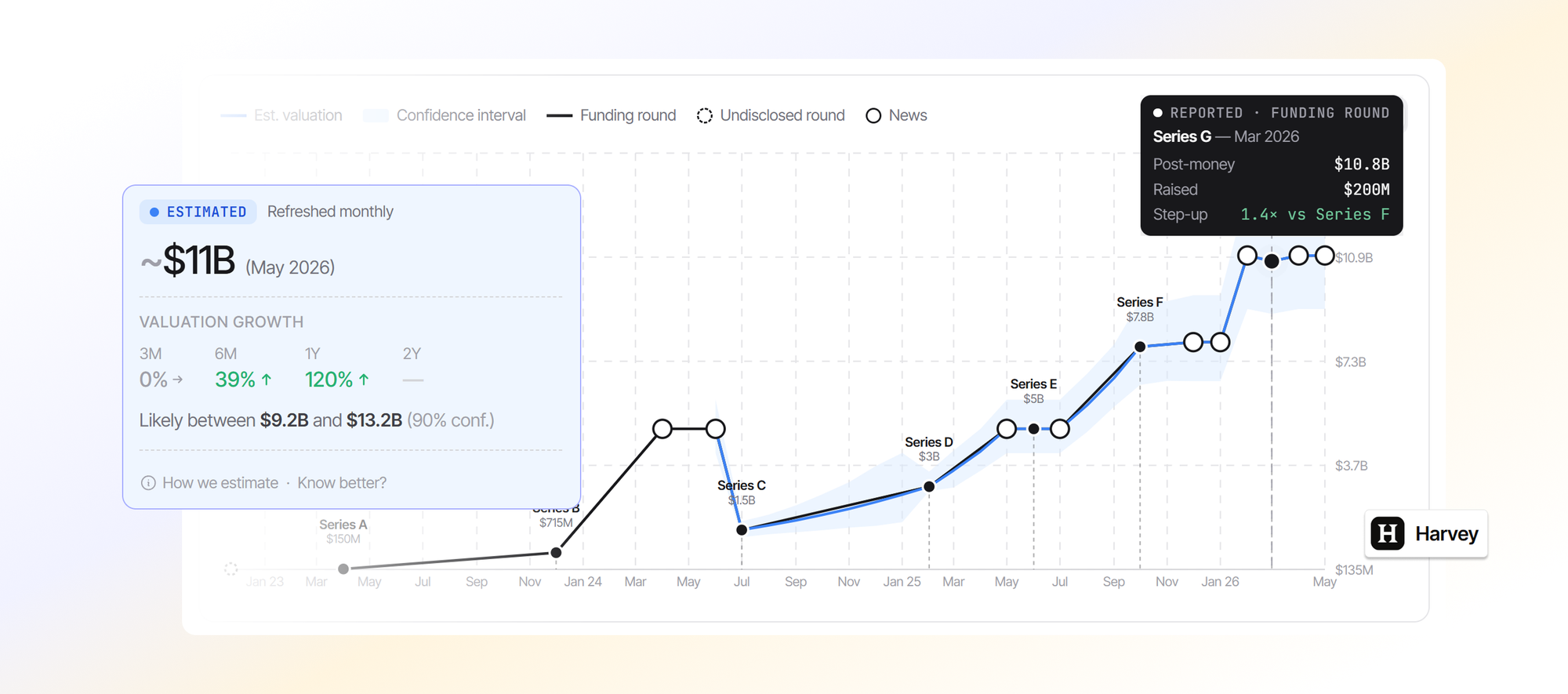
Two stacked ensembles, quantile-regressed, trained on real revenue and financing data, continuously anchored to live market signals. Sparse, messy reality in. A calibrated number with a confidence band out. On every company, every month.
Every company means every company
This is what makes it a category rather than a feature. Valuations exist elsewhere for a few thousand VC-backed names. We score and estimate revenue and valuations across the entire Specter universe each month, from two founders in a garage in Munich to pre-IPO decacorns, revenue and valuation both, each with a band that honestly reflects how much signal exists.
That coverage changes what screens can do. Rank a whole category by estimated revenue growth, and you see who's actually winning, instead of who raised most recently. The winners that slip past funding-based screens, the ones growing quietly on efficiency, show up here first, while the official record is still a year and a half behind.
The road from here
Similarweb made traffic a number every operator and investor checks without thinking. We're doing that for revenue and valuation: deeper financial register coverage beyond our current 50+ jurisdictions, and a model that keeps improving for every flavor of private company, from a bootstrapped agency to a consumer app to a deep-tech lab. The end state is a defensible, current number on any private company on earth, every month.
Estimated revenue and valuations are now live on Specter. The same data ships via API and flat file, alongside revenue signals and a set of new endpoints. If you want to see your market through it, talk to us.


